
Note: This piece reflects entirely my own personal experiences. I'll be sharing the side effects I lived through myself. These effects are very rare and it doesn't mean they will cause problems in everyone. Please consult your doctor in any situation.
Lithium is actually a medication that has been used safely for years. Doctors like using lithium in bipolar treatment because the response is usually good and patients tolerate it well. But with long-term use it can produce neurological effects such as tremor and memory problems. A high dose, on the other hand, can be toxic and lead to severe effects like ataxia, loss of balance, speech disturbance and nystagmus.
In my case it grew all the way into cerebellar shrinkage.
How Does Lithium Work in the Body?
Here I'd like to touch briefly on how lithium works. In Özdin and Sarısoy's article "Neurological side effects of lithium" it is explained like this:
“Although lithium easily enters the cell through sodium and potassium channels, it can only leave the cell through mechanisms that require energy. For this reason lithium can accumulate easily inside the cell. Lithium's exit from the cell is an energy-requiring event. It is very important to know that the balance of lithium between the inside and outside of the cell does not occur passively. Since almost all of it is excreted by the kidneys, dose adjustment is necessary in patients with kidney failure.
Its side effects can also be seen at normal serum lithium levels. Because of its small molecular structure, its ability to enter cells easily and be stored, it can cause side effects in almost every system.
Lithium has been shown to accumulate particularly in nerve cells; it is known that side effects related to the nervous system emerge even at normal serum lithium levels, and even at non-therapeutic levels.”
(Özdin & Sarısoy, 2013, p. 119)
The article also states that it is not known how lithium-related tremor develops.
This actually stems from the fact that lithium's mechanism of action is not fully known.
So it's a substance that can do a great deal of good, and affect a great many places. Mysterious. It penetrates everywhere, does its work “silently.” As for why it loves nerve cells so much, I couldn't find anything.
Let's come to the signs of poisoning.
Understanding this part matters, because no one could make sense of the symptoms I was having.
Signs of Lithium Poisoning
I actually talked about these in my piece What Is SILENT Syndrome? But it's worth recalling them.
Signs of mild poisoning
Signs of mild poisoning include: mild tremor, fatigue, muscle pain, muscle weakness, increased reflexes.
Signs of moderate poisoning
Signs of moderate poisoning include: intense tremor, ataxia, dysarthria, ringing in the ears, difficulty swallowing, hypertonia, sudden muscle jerks.
Signs of severe poisoning
Signs of severe poisoning include: epileptic seizure, coma, spasticity, muscle twitching/rigidity, involuntary movements, partial paralysis or full paralysis.
When cases that developed SILENT were examined, patients' serum lithium levels were found to vary between 0.1 and 8 mEq/L.
Alongside all these signs there is also the “high fever” part, which is very interesting.
It still hasn't been resolved whether lithium poisoning causes the high fever, or whether the poisoning appeared alongside an accompanying febrile infection.
If you ask me, high fever is one of the signs of poisoning. I'll explain why a little further below.
Do the Signs of Lithium Poisoning Improve?
After lithium is stopped, the picture related to the nervous system does not improve right away (Kesebir et al., 2001). The reason, as I noted above, is that lithium enters cells — especially nerve cells — easily, is stored, and is released slowly.
In SILENT syndrome, neurological effects such as ataxia, tremor and dysarthria are dominant. It has mostly been reported that these effects are permanent and that there is no improvement, or very little improvement. But various case reports have shown that, though rarely, there are cases that do improve.
The severity of the poisoning also matters.
If, in acute poisoning, lithium is stopped immediately, dehydration is corrected, dialysis is performed if necessary, other medications being used (if any) are adjusted, and other chronic conditions, if any, are kept under control, the neurological effects may recover faster.
In this disorder, improvement is more frequent in the first 12 months, and the likelihood of dysarthria improving is greater than the likelihood of ataxia improving.
In my case, lithium wasn't stopped (while I was hospitalized they kept giving me lithium to take), and because no one suspected lithium (:)) I went on taking lithium until there was damage in my cerebellum (about 8 more months).
As a result: lithium kept accumulating in my brain and led to cerebellar atrophy.
It's like a joke.
“Neuropathological studies in patients who developed SILENT have shown a decrease in the number of Purkinje cells along with basket cells in the cerebellar cortex, and spongiform changes in the white matter and the dentate nucleus.”
(Özdin & Sarısoy, 2013, p. 121)
What Effects Did I Have?
The poisoning in me is a more complicated process than I thought.
Until I had a high fever in April 2023 I apparently had some neurological signs, but I hadn't noticed them. Roughly, this is how things went for me:
In 2022 occasional tripping and foot dragging began.
In the autumn of 2022 chronic fatigue and forgetfulness began.
In January 2023 severe lower back pain began. I was having insomnia and nausea (may not be related).
In March 2023 I suddenly began to be unable to see at a distance.
At the end of March – beginning of April 2023 my muscles tired very quickly and ached. I was getting tired fast.
At the beginning of April 2023 extreme anger and depression were added to these symptoms too.
And on 9 April 2023, in a very angry moment, my fever rose along with a very strange headache unlike anything else.
I described that day and what happened afterwards in my piece Finding Myself While Losing My Balance: The Beginning of My Neurological Journey .
What followed was a disaster: a 40-degree fever that wouldn't come down, a lesion in the brain (in the corpus callosum), loss of balance, speech disturbance, vision disturbance, tremor, weakness, muscle twitches, excessive sweating (it came in sudden attacks).
All these effects were assessed as if they were encephalitis and lithium was persistently not stopped.
And my serum lithium value came back as "1.39". But somehow it was overlooked.
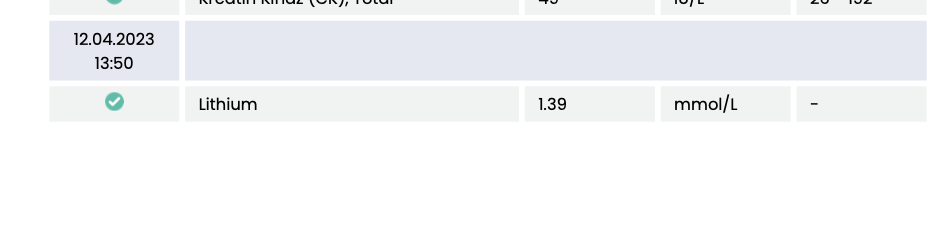
I got even worse in the hospital.
At the end of my 25-day hospital stay I was practically like a baby; I could neither sit, nor speak, nor make any movement at all.
It was as if my brain had been reset.
And that's a bit what happened.
For 3 years, by exercising nonstop, working, paying attention to everything, I managed to become semi-independent.
Of course I still have a road ahead of me…
By the way, I'm also going to hold them accountable for these wrong interventions done to me.
Not long now.
I hope no one is ever harmed in any way by the medication/doctor/hospital they trusted in order to get better.
References
Kesebir, S., Akdeniz, F., & Vahip, S. (2001). Lityum zehirlenmesine bağlı koreatetoz: Bir olgu ve literatürün gözden geçirilmesi. Türk Psikiyatri Dergisi, 12, 315–319.
Özdin, S., & Sarısoy, G. (2013). Lityumun nörolojik yan etkileri. Journal of Mood Disorders, 3(3), 119–127. https://doi.org/10.5455/jmood.20130521121833
Comments · 0
0 comments