On learning to listen — and what I found in the dark
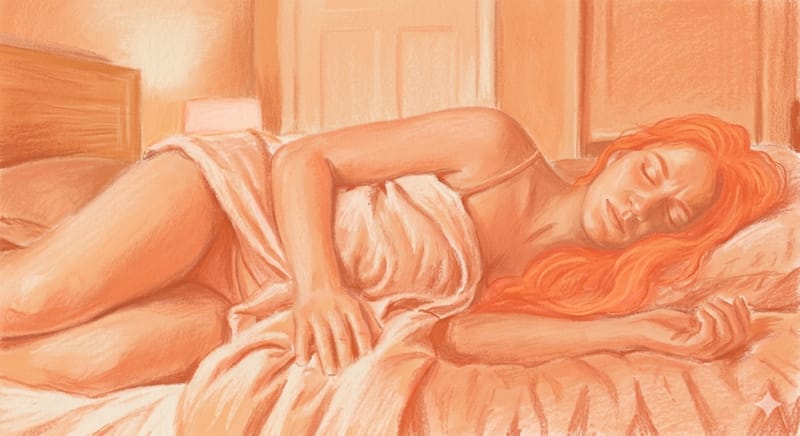
Last night I lay in bed and began a body scan.
It was something I had done many times before. But that night, something was different.
There was something strange. Something I couldn’t name. A darkness. In my body. In my face. Like emptiness. Like absence.
Can a person actually perceive absence? Can they describe it? I’m not sure. But it was there. On the left. The outer edge of my face. The corner of my left eye. The far left border of my body.
Gone.
Dark.
I was frightened. Confused. I opened my eyes. I could see. I touched my face — everything was in its place.
But inside… nothing.
That discovery carried me to a new level in my healing.
Three years ago, lithium toxicity caused cerebellar atrophy. It took my balance, my speech, my coordination. Since then, I have been in physiotherapy, learning to reclaim what was lost — slowly, movement by movement, word by word.
For the past year and a half, I have been practicing mindfulness, body scan, and somatic work. Mostly guided meditations. For most of that time, I realize now, I was approaching my body from the outside — watching it through a third eye, imagining the body I wanted to reach, always practicing for a purpose.
But mindfulness, at its core, is something else. It is being inside the moment. Diving into the exploration of this home we live in — our body. Being in the flow. Finding ourselves.
For a long time, I was angry at my body. Exhausted by three years of struggle, I stopped listening. And perhaps because of that, it stopped talking to me. Now we have something different — a mutual respect, a kind of love. And because of that, I can now clearly see where something is wrong, or where something might go wrong.
I wasn’t wrong to try. Living with ataxia is not easy. It is full of unpredictability, and learning to navigate that uncertainty is a task in itself. My body and my brain have been generous — they send me signals, small messages. Over time I learned their language: when my body doesn’t want to move, when it needs a particular mineral or vitamin, when it needs to release tension. I got it wrong sometimes. My body got frustrated with me. But slowly, we found a way to understand each other.
What happened last night was the clearest proof of this.
I cannot perceive my left side.
I thought about it for a long time. Then the answer came — and it was obvious, once I saw it.
A few months after leaving the hospital, my therapist and I had noticed that my head kept wanting to turn to the right. When she walked me with my eyes closed, I would automatically drift right. My balance center had shifted. I assumed it was a normal consequence of the atrophy. But what was really happening was this: my brain had never trusted my left side. It was carrying my whole body on the right. This caused my right side to compensate enormously — to tense, to overwork, to exhaust itself trying to hold everything together.
Over time, with work, this improved. I began to trust my left foot more. But the underlying distrust had quietly accumulated — and now it had become impossible to ignore.
When I began to work with that “absence” I observed in the body scan, something became clear: my left eye is weak, and my brain does not trust the signals coming from the left. When I closed my right eye — even just sitting still — pain entered my head, my balance began to slip, and my body clenched its right side, especially the right jaw, trying to compensate.
Whatever happened in that hospital room affected my left eye more deeply than I had understood. The brain’s entire mapping of “left” had shifted.
But now I know exactly where to focus. And that changes everything.
Understanding the body matters so much.
When we are healthy, we barely notice the signals our bodies send us. We move through the world without listening. And then — when everything changes — even the smallest message becomes precious.
Descartes told us the mind and body are separate substances — that the thinking self is distinct from the flesh it inhabits. For centuries, Western philosophy built on that divide. But lying in the dark, unable to feel the left side of my face, I understood something that no argument could have taught me: the self does not float above the body. It is mapped onto it. When the map breaks, something in the self goes missing too.
Maurice Merleau-Ponty spent his life arguing against that Cartesian split. For him, the body is not an object the mind inhabits — it is the very medium through which we exist in the world. We do not have bodies; we are our bodies. Perception, identity, even thought itself, are grounded in lived, felt, physical experience. He called this the lived body — the body as it is experienced from within, not observed from without.
I did not learn this from a philosophy book. I learned it in the dark, at the edge of my own left side.
Healing the body, I have come to understand, is not separate from knowing who you are. They are the same work.
We are all on a journey through this life, and we carry our homes with us: our bodies. Imagine being covered entirely in that feeling of absence, of darkness, of not-there.
What a terrifying thing that would be.
So listen. Before you have to.
Comments · 0
0 comments