


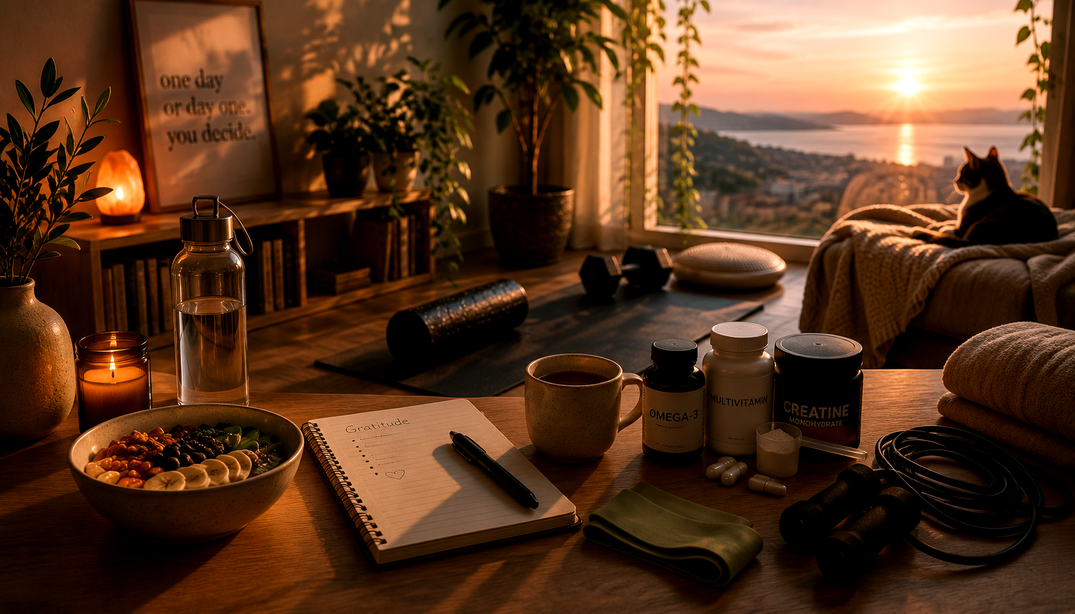

Before I start, I want to make one thing clear: this is my personal recovery protocol. It has gradually evolved through my own experience, research, and the guidance of my doctors and therapists. These are simply the things that have worked well for me. Everyone’s recovery is different.
I try to follow this routine at least four days a week, and ideally up to six days. I always keep one full rest day, and during weeks when I’m especially fatigued, I reduce the intensity and focus on recovery.
Morning
After getting ready for the day, the first thing I do is write in my gratitude journal.
Then I spend about 10 minutes doing a body scan. This has become one of the most important parts of my routine because I struggle with body mapping, especially on my left side. Since I don’t naturally trust my left side very well, consciously reconnecting with my body every morning helps me build that awareness.
Next, I go outside for 10–15 minutes of sunlight.
After that, I eat a high-calorie, gluten-free breakfast, followed by my supplements:
- Multivitamin
- Omega-3
- Creatine
Note: I highlighted the “gluten free” part because gluten makes my tremors worse, so my neurologist said that I should cut off gluten completely.
Physical Rehabilitation
Most days I have around two hours of physical therapy.
We work on:
- Balance
- Coordination
- Aerobic conditioning
- Eye exercises
- Reflex training
- Motor control
On days without physical therapy, I do my own balance and coordination exercises at home.
After every PT session, I continue with:
- Eye exercises
- Facial muscle exercises
- Speech and tongue exercises
- Breathing exercises
I also make sure to stretch afterward.
If my energy levels allow, I add a strength training session before stretching.
Cardio
I aim for at least 150 minutes of cardio each week, spread across a minimum of four days.
I usually choose:
- Walking on the treadmill
- Stationary cycling
- Jumping
- Step dance
I strongly recommend you to read on importance of aerobic exercise for neuroplasticity that I wrote about.
Cognitive & Visual Training
In the evenings, I still play VR games whenever I can. Sometimes I play computer games instead.
These have been great for improving:
- Reflexes
- Hand coordination
- Eye tracking
- Reaction speed
Whenever I have a few spare minutes during the day, I also play short reaction-time or brain-training games on my phone for about 5–10 minutes.
Throughout the Day
Since I have difficulty trusting and sensing my left side, I constantly give myself little reminders throughout the day.
I intentionally think things like:
- “My left hand is here.”
- “I’m using my left side.”
- “My left eye is seeing.”
- “My left side is part of my body.”
I’m constantly trying to stimulate and reinforce those neural pathways.
Sometimes I also apply deep pressure to my body while sitting or lying down. I even do this before sleep because it helps me feel more connected to my body.
And…
Recovery also happens outside of my “training sessions.” Alongside all of this, I work, try to maintain a social life, cook, clean, take care of my cats, and get outside whenever I can. I also see my psychologist once a week because mental health has been just as important as physical rehabilitation.
Evening Recovery
Dinner is another gluten-free meal, usually around 7 p.m.
After that, I intentionally switch into recovery mode because after such an intensive day, rest is just as important as training.
My evening usually includes:
- A warm shower
- Dim lighting
- Nature sounds or relaxing frequency music
- Reading a book (which also gives my eyes gentle practice)
Sleep
Right before bed, I practice the 4-7-8 breathing technique for about five minutes, and I also take magnesium. In addition, I meditate and finish the day with another body scan.
Sleep is one of my biggest priorities.
I usually sleep 8–10 hours, and I try not to go below eight hours because my recovery depends on it.
Occasionally, I’ll leave relaxing frequency music playing while I fall asleep, although I don’t do this every night.
This has become my personal ataxia recovery protocol. I started following it consistently this year, and I’ve seen significant improvements. It may not be the right approach for everyone, but it’s the routine that has helped me the most on my own recovery journey.

Comments